Best 1 Gallon Betta Fish Tank Heater — Safe Compact Heaters for Small Tanks
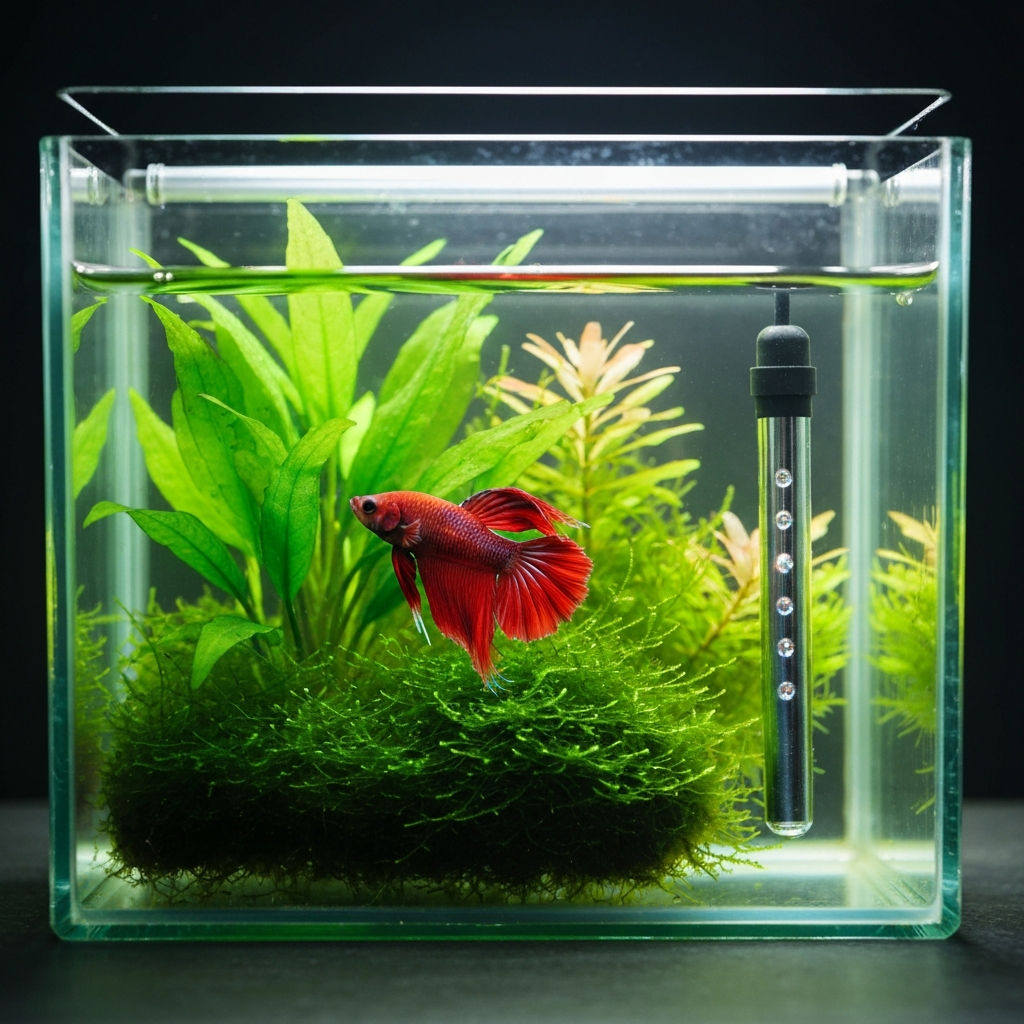
When I brought home my first betta, a stunning crowntail I named Poseidon, I did what so many of us do. I listened to the kid at the big-box pet store. He handed me a tiny, one-gallon plastic "betta condo," a bag of colorful gravel, and a container of flakes. "They're easy," he said. "They live in puddles in the wild."
I learned the hard way that this is one of the most pervasive and harmful myths in the fishkeeping world. Poseidon was lethargic, his beautiful fins were often clamped, and he spent most of his time just sitting at the bottom. My room was a bit chilly, and his water was cold to the touch. I realized he wasn't "easy;" he was freezing. My frantic search for a "1 gallon betta fish tank heater" began, and it led me down a rabbit hole of dangerous products, conflicting advice, and near-disasters.
That experience is the reason I started my blog. I want to save you the stress and your betta the suffering. Heating a tank this small is like walking a tightrope. It's incredibly difficult to do safely. Most heaters will cook your fish, while others won't do enough.
So, let's talk honestly. In this guide, I'll show you the very few options that can work, how to use them without accidentally boiling your fish, and why your long-term goal should be a bigger tank. If you're stuck with a 1-gallon tank for now, this is how you make it survivable.
Why Heating a 1-Gallon Betta Tank is Crucial (and Dangerous)
Before we even look at products, you need to understand the stakes. Getting this wrong is one of the fastest ways to harm your betta.
The Tropical Truth About Bettas
Betta splendens are not from puddles. They hail from the warm, slow-moving waters of rice paddies, marshes, and streams in Thailand and Cambodia. Their environment is consistently warm. To thrive, they need their water to be a stable 78°F to 82°F (25.5°C to 27.8°C).
When their water is too cold, their metabolism slows down dramatically. They become lethargic, lose their appetite, and their immune systems weaken, making them easy targets for diseases like Ich, Fin Rot, and fungal infections. A consistently warm betta is an active, vibrant, and healthy betta.
The 1-Gallon Tightrope Walk
Here's the physics problem: a small volume of water changes temperature very, very quickly. Think about a tiny cup of coffee versus a large pot—the cup gets cold in minutes. Your 1-gallon tank is that tiny cup.
- Risk of Overheating: Most aquarium heaters are designed for 5, 10, or 20+ gallons. A 25-watt or 50-watt heater, the most common sizes, will turn a 1-gallon tank into a hot tub in under an hour, literally cooking your fish.
- Risk of Temperature Swings: Even a "correctly" sized heater will cycle on and off frequently, causing the temperature to swing up and down. These fluctuations are incredibly stressful for a betta's system.
Your mission is to find a heater with the lowest possible wattage that is reliable enough not to fail and overheat the tank. It's a tall order.
The Hard Truth: A 1-Gallon Tank is Not a Forever Home
I have to be direct here because I care about the health of your fish. A 1-gallon tank is not a suitable permanent home for a betta. It's simply too small to provide a stable environment or adequate swimming space.
Think of it as a temporary hospital tank or a quarantine setup at best. The tiny volume makes it impossible to establish a stable nitrogen cycle, meaning you're constantly fighting toxic ammonia spikes. For the long-term health and happiness of your betta, your number one priority should be upgrading to a minimum of a 5-gallon tank. A 5-gallon setup is infinitely easier to heat safely, keep clean, and provides the space your betta needs to explore and behave naturally.
That said, I know people end up with these tanks. If you're using one right now, let's focus on making it as safe as possible while you plan that upgrade. The first step is a reliable heating solution.
My Top Recommended Heaters for 1-Gallon Betta Tanks
After years of testing and seeing countless horror stories from cheap, malfunctioning heaters, I only recommend a few specific types for a tank this small. Your priorities are low wattage, reliability, and a small physical footprint.
Best Overall: The Low-Wattage Preset Heater
For a 1-gallon tank, a simple, low-wattage preset heater is often the safest bet. You don't have to worry about accidentally setting it too high. The key is to find one that is preset to an appropriate betta temperature (around 78°F) and has an automatic shut-off. The Aqueon Betta Heater is one of the few on the market designed specifically for this purpose.
Aqueon Aquarium Betta Heater
At 7.5 watts, this is one of the lowest-power submersible heaters you can find. It's designed to raise the water temperature in a small bowl or tank by about 5-10°F above the ambient room temperature. It's fully submersible and has a simple, no-fuss design. While it won't give you precise control, its low power makes it far less likely to cause a catastrophic overheating event compared to more powerful heaters. It's my go-to recommendation for beginners with tanks under 2 gallons.
Best for Control (Use With Extreme Caution): The Mini Adjustable Heater
If your room is very cold and a preset heater isn't quite getting the water into that 78°F sweet spot, a small adjustable heater is your next option. I hesitate to recommend these for 1-gallon tanks because the potential for user error is high. However, if you are meticulous about monitoring, the FREESEA 25W heater is one of the smallest and most popular options. CRITICAL: You must use this on its lowest setting and verify the temperature with a separate thermometer.
FREESEA 25W Mini Aquarium Heater
This is a 25-watt heater, which is technically overpowered for a 1-gallon tank. However, its adjustable nature and tiny size make it a candidate if used carefully. I've used this in 3-gallon hospital tanks with success. For a 1-gallon, you MUST set it to the lowest possible temperature (78°F) and watch your separate thermometer like a hawk. Its main advantage is the ability to dial in the exact temperature, but its power is also its biggest risk.
Safest Alternative: The Under-Tank Heating Pad
An often-overlooked solution for nano tanks is an under-tank heating pad, typically marketed for reptile terrariums. This provides gentle, indirect heat through the bottom of the tank. It's much harder to accidentally overheat your water this way. The downside is that it's less efficient and the heat you get is highly dependent on your room temperature. It's a great option for taking the chill off and raising the water temp a few degrees safely.
iPower Reptile Under Tank Heat Pad
This is my favorite "safety-first" approach. I recommend the smallest size (e.g., 4x7 inch, 4-watt). You simply stick it to the underside or the back of your plastic or glass tank. It provides very gentle, constant warmth. It won't get your tank to a precise 80°F, but it will reliably keep it out of the cold danger zone. For best results, use the included plastic feet to elevate the tank slightly, allowing for air circulation.
The Single Most Important Accessory: A Digital Thermometer
If you buy nothing else from this guide, buy this. Never, ever trust the thermostat on your heater or the sticker on the side of your tank. They are notoriously inaccurate. A reliable, separate digital thermometer is non-negotiable. It is the only way to know the true temperature of your water and keep your betta safe.
VIVOSUN Digital Aquarium Thermometer
These little digital thermometers are cheap, accurate, and easy to read. I have one in every single one of my tanks. You just suction cup the probe inside the tank (opposite the heater for the most accurate reading) and stick the display on the outside. This gives you a constant, at-a-glance reading of the water temperature. It's your early warning system against a malfunctioning heater.
Comparison of 1-Gallon Heating Solutions
Here’s a quick breakdown of the options to help you decide.
| Product | Type | Wattage | Key Pro | Key Con |
|---|---|---|---|---|
| Aqueon Betta Heater | Submersible Preset | 7.5W | Extremely simple, low risk | No temperature control |
| FREESEA Mini Heater | Submersible Adjustable | 25W | Precise temperature control | High risk of overheating if used improperly |
| iPower Heat Pad | Under-Tank Pad | 4W+ | Safest option, provides gentle heat | Inefficient, won't reach a specific temp |
Frequently Asked Questions (FAQ)
- Can I just use a 50-watt heater I already have?
- Absolutely not. I cannot stress this enough. A 50-watt heater, or even a 25-watt heater used carelessly, will boil a 1-gallon tank in a very short amount of time. It is a death sentence for your fish. The wattage must be matched to the volume, and for 1 gallon, that means you need the lowest power possible.
- My preset heater isn't getting the water to 78°F. What's wrong?
- Nothing is "wrong"—this is the expected behavior of these low-power heaters. They are designed to raise the water temperature by a set amount (e.g., 5-10°F) above the room's temperature. If your room is 65°F, the heater might only get the water to 73-75°F. This is still far better than 65°F! The best solution is to keep the room your betta is in warmer. This highlights another limitation of such a small tank.
- Do I need to run the heater 24/7?
- Yes. The goal is temperature stability. A good heater has an internal thermostat that will turn the heating element on and off automatically to maintain its target temperature. You plugging it in and out manually will just create the stressful temperature swings we're trying to avoid.
Final Verdict: Your 1-Gallon Tank Heating Checklist
Look, I get it. You have a 1-gallon tank and you want to do the right thing for your fish. Taking heating seriously is a massive and commendable step in the right direction. But the best thing you can do for your betta's long-term health is to start planning an upgrade to a 5-gallon tank with a filter. It will make your life easier and your betta's life infinitely better.
In the meantime, here is your safety checklist:
- Choose the safest, lowest-wattage option. For most people, that is the Aqueon 7.5W Betta Heater. It's the least likely to cause a disaster.
- Buy and install a separate digital thermometer. This is not optional. Place the probe away from the heater.
- Install the heater carefully. Make sure it is fully submerged and not touching gravel, decorations, or the tank walls. Let it sit in the water for 30 minutes before plugging it in.
- Monitor, monitor, monitor. For the first 48 hours, check the digital thermometer constantly. Ensure the temperature is stable and not climbing into the danger zone (above 84°F).
- Start a "Tank Upgrade" fund. A complete 5-gallon kit can often be found for under $50. It is the single best investment you can make in your betta's health and happiness.
You're trying to provide a good home for your pet, and that's what matters. Use this guide to keep him safe for now, and get excited about giving him the space he truly deserves soon. Happy fishkeeping!