5 Gallon Betta Tank Setup — The Exact Equipment I Use
My first betta tank was a disaster. I walked into Petco, grabbed a 1.5-gallon "betta kit" for $25, and thought I was being a responsible fish owner. It came with a plastic plant, rainbow gravel, and no heater because "bettas don't need them."
My betta was dead in 11 days.
Seven years later, I've set up probably 15 betta tanks. I've tested cheap equipment and expensive equipment. I've killed plants and grown jungles. Here's exactly what I'd buy today if I were starting from zero — with specific product names, real prices, and zero sponsorship.
The Tank: 5 Gallons Is the Sweet Spot
You can go bigger — a 10-gallon is fantastic — but 5 gallons is the minimum I recommend and it's what most people have space for.
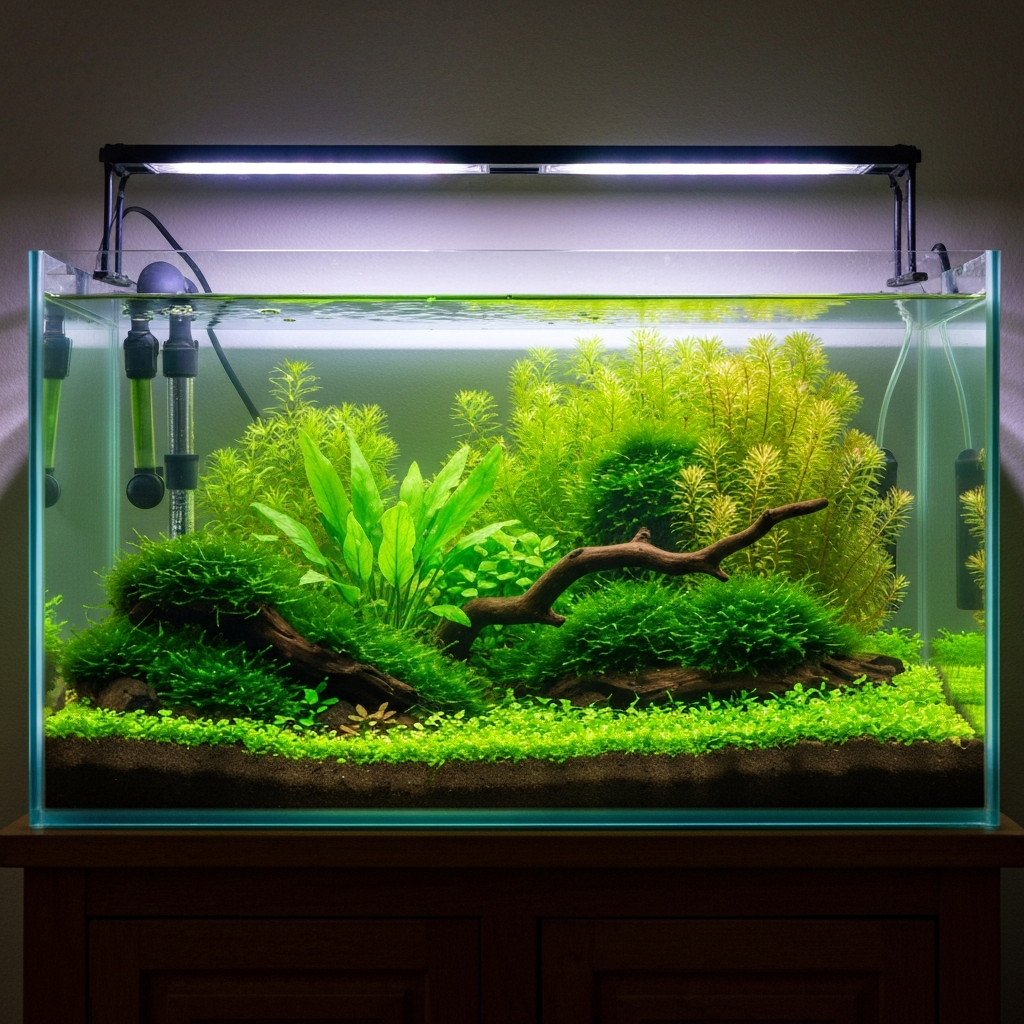
My pick: Fluval Spec V ($99 at Petco, often on sale for $79). It's a 5-gallon rimless tank with a built-in filter compartment in the back. The stock light grows low-light plants. The filter output is too strong out of the box — more on that in a minute — but it's fixable in 30 seconds.
Fluval Spec V 5-Gallon Rimless Aquarium
Our absolute top pick for any betta keeper. This elegant rimless glass tank features a concealed 3-stage filtration system and a sleek LED light ideal for beautiful plant growth. Fits on any desk or counter.
If $99 is too steep, the Aqueon 5.5-gallon standard glass tank is $14 at Petco during the dollar-per-gallon sale. You'll need to buy a lid, light, and filter separately, which adds up to about $60 total. Still cheaper than the Fluval, but doesn't look as clean.
Do not buy: The Top Fin "Betta Falls" or any of those multi-compartment waterfall tanks. They're 1.5 gallons total split across three sections, the filter is useless, and bettas can jump between compartments. I've rescued two bettas from these abominations.
Heater: Adjustable, Not Preset
Preset heaters claim they maintain 78°F. They don't. I've tested three brands with a digital thermometer and they ranged from 72°F to 84°F. That's a 12-degree swing that'll stress any fish.
My pick: Fluval M50 Submersible Heater ($25). It's a 50-watt adjustable heater for 5–15 gallon tanks. It's slim — about 8 inches long and less than an inch thick — so it fits in the filter compartment of the Fluval Spec V, which keeps it hidden. The temperature dial is calibrated in 2-degree increments and actually matches my thermometer reading.
Fluval M50 Submersible Heater (50W)
A premium, highly reliable 50-watt adjustable heater. Fits perfectly inside the back chamber of the Fluval Spec V to keep your display completely clutter-free while maintaining stable, safe temperatures.
The Eheim Jager 50W ($28) is equally good. Slightly longer but built like a tank — my oldest one is 5 years old and still running. Either one is fine. Just avoid the Tetra HT submersible ($12) — the suction cups fail after about 3 months and the thermostat drifts.
And buy a thermometer. The Marina floating glass thermometer is $3. Glue the suction cup to the inside of the glass. Heaters lie. Thermometers don't.
Filter: Low Flow Is Critical
Bettas are terrible swimmers. Their big fins create drag, and strong current exhausts them. If your betta is getting pushed around by the filter output, he's stressed. Stressed bettas clamp their fins, hide, and get sick.
If you're using the Fluval Spec V, the stock pump is too strong. The fix: cut a small piece of filter sponge and wedge it into the output nozzle. Takes 10 seconds and drops the flow by half. Some people also drill extra holes in the output tube, but sponge works fine.
If you're using a standard tank with a separate filter, get a sponge filter. The Aquarium Co-Op sponge filter ($10 for the small size) + an air pump like the Tetra Whisper 10 ($6) + airline tubing ($3). Total: about $19. Silent, gentle flow, excellent biological filtration, and bettas love swimming through the bubbles.
Do not buy: Hang-on-back filters like the Aqueon QuietFlow for a 5-gallon. Even the smallest model creates a waterfall effect that batters your betta. If you absolutely must use a HOB, baffle the output with a water bottle cut in half or a piece of filter sponge.
Substrate: Skip the Rainbow Gravel
I'm going to be direct: colored gravel looks cheap and unnatural. Your betta doesn't care what color the gravel is, but you'll be looking at this tank every day. Black sand or natural-looking fine gravel makes plants and fish pop.
My pick: CaribSea Super Naturals Aquarium Sand in "Crystal River" ($12 for 10 lbs). It's a natural beige/tan sand that doesn't need rinsing (seriously — pour it straight in, zero cloudiness). One 10-lb bag gives you about 1.5 inches of substrate in a 5-gallon tank, which is perfect.
If you want black, the Imagitarium Black Aquarium Sand ($8 for 5 lbs at Petco) is decent. Rinse it first — it's dusty. Black sand makes betta colors absolutely pop, especially reds and blues.
If you're planting rooted plants (cryptocorynes, swords, valisneria), add a layer of Fluval Stratum ($18 for 4.4 lbs) underneath the sand. It's an aquasoil that feeds plants for about a year. Not necessary for rhizome plants like anubias and java fern — they feed from the water column.
Plants: Start With the Unkillable Ones
I've killed more plants than I care to admit. Here are the three that survived my learning curve:
Anubias nana ($7 at any fish store). Attach it to driftwood or a rock with a drop of super glue gel (yes, regular super glue — it's aquarium safe once dry). Don't bury the rhizome in the substrate — it'll rot. Anubias grows maybe one leaf a month but it's basically immortal. Low light, no CO2, no fertilizer needed.
Java fern ($6). Same deal — attach to hardscape, don't bury the rhizome. It reproduces by growing baby plants on the tips of its leaves. After about 6 months you'll have more java ferns than you know what to do with.
Marimo moss ball ($4). It's actually an algae ball, not moss. Drop it in. That's it. Bettas sometimes push them around the tank, which is entertaining. Change the water around it every few weeks or it'll get sad and brown.
Once you've kept these alive for 3 months, graduate to amazon sword ($5) and cryptocoryne wendtii ($5). Both need root tabs — little fertilizer capsules you push into the substrate every 3 months. Seachem Flourish Tabs, $10 for a 10-pack.
Hardscape: Driftwood Makes Everything Better
A single piece of spider wood or mopani wood transforms a tank from "glass box with water" to "slice of nature." Plus, driftwood releases tannins that tint the water amber — exactly what bettas evolved in.
Mopani wood ($8–15 at Petco) sinks immediately. Spider wood ($10–20 at aquarium shops) floats for a week — weigh it down with a rock. Both release tannins. If you don't want tea-colored water, boil the wood for an hour first. I personally like the blackwater look.
Add one piece of wood with anubias attached, some java fern on a rock, and a marimo ball. That's a complete, natural-looking aquascape for under $40 in plants and hardscape.
The Complete Shopping List
Here's everything, with real prices as of 2026:
- Fluval Spec V tank — $99 (or Aqueon 5.5 gal — $14)
- Fluval M50 heater — $25
- Marina thermometer — $3
- Filter sponge (for baffle) — $3
- CaribSea sand, 10 lbs — $12
- Mopani wood — $10
- Anubias nana — $7
- Java fern — $6
- Marimo moss ball — $4
- Seachem Prime (water conditioner) — $8
- API Master Test Kit — $25
Total with Fluval: ~$202. With Aqueon tank: ~$117.
Is two hundred bucks a lot for "just a fish"? Maybe. But that tank will run for years. A betta in a properly set up 5-gallon lives 3–5 years. One in a bowl lives 3–5 weeks. Divide $200 by 4 years and you're paying about $4 a month for a thriving pet.
That's less than a Netflix subscription. And bettas don't cancel shows you're halfway through.
Related Guides
Alex Rivera
I've set up enough betta tanks to fill a pet store. Everything I recommend here is equipment I actually own and use.