Betta Fish Types — 15 Colors & Tail Patterns Explained
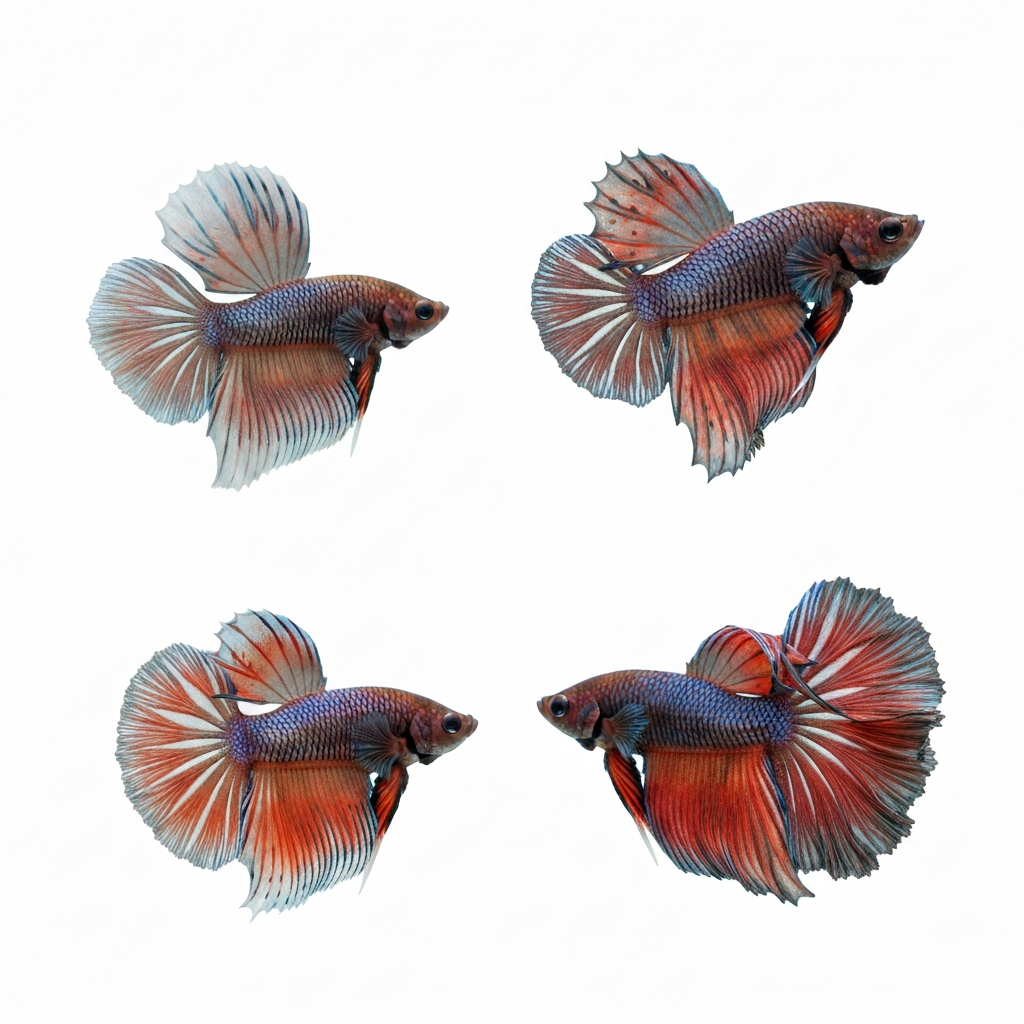
Walk into any aquarium store and you'll see rows of little cups, each holding a betta that looks completely different from the one next to it. One might have a flowing veil-like tail in solid royal blue. The next might be a marble koi with splashes of red, black, and white. The one after that might have fins that look like a crown.
These aren't different species. Every single one is Betta splendens — the same species that wild bettas belong to. The jaw-dropping variety you see in stores comes from over a century of selective breeding in Thailand and across Southeast Asia.
If you're shopping for a betta and feel overwhelmed by the choices, this guide breaks down every major tail type, color pattern, and the rarest varieties you might encounter. After seven years of keeping bettas, I've owned most of these types — and I'll tell you which ones hold up best in home aquariums.
Bettas in the Wild vs. Store Bettas
Wild Betta splendens look nothing like the fish in pet stores. They're small, with short fins and muted brown-green bodies with subtle red or blue iridescence. They evolved for survival in murky rice paddies and slow-moving streams — not for looking pretty in glass boxes.
Everything you see on store shelves — the three-inch fins, the metallic scales, the marble patterns, the pure white "cellophane" bettas — is the result of generations of selective breeding. Breeders in Thailand and Indonesia have spent decades isolating specific traits: longer fins, brighter colors, thicker scaling. The betta you buy for $8 at a chain store represents generations of careful genetic work.
Understanding the difference between wild types and domestic types matters because it affects care. Domestic bettas with massive fins (like rosetails and over-halfmoons) struggle to swim. Plakats and wild-type hybrids are more active and hardier. More on that below.
Tail Types: The 8 Most Common Betta Tail Shapes
Tail type is the first thing most people notice about a betta. It's the main way breeders categorize their fish, and it dramatically affects how the fish moves and behaves.
1. Veiltail — The Beginner's Betta
This is the betta you see in every chain pet store. The veiltail has a long, asymmetrical caudal fin that droops downward, giving it a "veil" appearance. The anal fin is also elongated and trailing.
Personality: Veiltails are the most common type for a reason — they're hardy, widely available, and inexpensive ($5–15). Their fins aren't as heavy as rosetails or over-halfmoons, so they swim reasonably well. If you've never kept a betta before, start here.
Watch for: Poor breeding in mass-produced veiltails. Look for active fish with fully extended fins and no clamped or ragged edges.
2. Crowntail — The Punk Rock Betta
Crowntails have webbing between their fin rays that's reduced by 33% or more, creating a spiky, crown-like silhouette. The rays extend past the webbing, giving each fin a jagged, dramatic edge. A good crowntail has at least a "double ray" (two extensions per fin ray) and ideally a "triple ray" or "cross ray" pattern.
Why they're special: Crowntails look unlike anything else in the aquarium hobby. Under good lighting, the extended rays catch light individually, creating a shimmering, almost holographic effect. They tend to be hardy and active.
Watch for: Fin curling. If the extended rays curl backward instead of staying straight, it's usually a sign of poor water quality during development. The curling is permanent.
3. Halfmoon — The Showstopper
A true halfmoon betta has a caudal fin that spreads to exactly 180 degrees — a perfect half-circle when fully flared. The dorsal and anal fins are proportionally large, creating a near-continuous fan shape around the entire body. This is the most prized tail type in competitive showing.
What you're paying for: Halfmoons are the result of meticulous line breeding. A quality halfmoon from a reputable breeder can cost $30–80+. They photograph beautifully and make stunning display fish.
The downside: All that fin mass is heavy. Halfmoons tire easily, need resting spots near the surface (betta hammocks or broad-leaf plants), and are more prone to fin rot and fin biting. Not ideal for beginners.
4. Plakat — The Athlete
Plakats are the short-finned bettas. Their name comes from the Thai word plakad, meaning "biting fish" — these are the original fighting line. They have compact, D-shaped caudal fins and short, muscular bodies. Modern show plakats have been bred for symmetrical, rounded fins rather than fighting ability, but they retain the athletic build.
Why I recommend them: Plakats are the healthiest, most active betta type you can buy. They swim effortlessly. They're less prone to fin problems. They can comfortably live in a 5-gallon tank when long-finned varieties might struggle. If you want a betta that actually swims instead of mostly floating, get a plakat.
Sub-types: Traditional plakat (rounded fins, wild-type body), halfmoon plakat (HMPK — short fins with the 180-degree spread), and crowntail plakat (spiky rays on short fins). HMPKs are currently the most popular show variety.
5. Doubletail — The Split Fin
Doubletail bettas have a caudal fin split into two distinct lobes, caused by a genetic mutation that produces a broader caudal peduncle. The two lobes are usually symmetrical and can be any tail type — you'll see doubletail halfmoons, doubletail plakats, and occasionally doubletail crowntails.
What to know: The same gene that splits the tail also shortens the body. Doubletails have noticeably shorter, stockier bodies than single-tail bettas. This makes them more prone to swim bladder issues. That said, a healthy doubletail halfmoon is genuinely stunning — the split creates a butterfly-like silhouette when the fish flares.
6. Delta & Super Delta
A delta tail spreads to less than 180 degrees — typically 120–160 degrees — with straight, evenly spaced rays. A super delta approaches 170 degrees but doesn't quite hit the full 180. Think of deltas as "almost halfmoons" — they have the fan shape without the extreme fin mass.
Why consider a delta: They give you about 90% of the halfmoon look with significantly fewer health problems. The reduced fin weight means better swimming and less fin rot risk. Underrated choice.
7. Rosetail & Feathertail — The Extreme
Rosetails take the halfmoon shape and push it further: excessive branching in the fin rays creates a ruffled, rose-petal appearance. Feathertails take it even further — the rays branch so extensively the fins look like delicate feathers. These are the most extreme fin varieties in the hobby.
Honest opinion: I don't recommend rosetails or feathertails for beginners. The fin mass is so extreme that these fish struggle to swim. They're prone to fin biting (they'll literally chew off their own fins because they're too heavy), chronic fin rot, and exhaustion. They often can't reach the surface easily. Beautiful? Absolutely. Ethical breeding? Debatable. If you must have one, provide a shallow tank (under 12 inches deep) with abundant resting spots near the surface.
8. Dumbo Ear (Elephant Ear)
Dumbo ear bettas have enlarged pectoral fins that resemble elephant ears. These fins are typically a contrasting color — white or translucent against a colored body — and flap noticeably as the fish swims. The "dumbo" trait can appear on any tail type, though it's most commonly paired with halfmoons and plakats.
Appeal: The oversized pectorals give these fish an almost cartoonish, endearing appearance. When they swim, the ear-like fins paddle in a way that genuinely looks like flying. They've exploded in popularity over the last five years.
Note: The enlarged pectorals are purely cosmetic. They don't affect health or swimming ability the way extreme caudal fins do. Dumbo plakats are an excellent choice for someone who wants something unique without the health baggage of a rosetail.
Color Patterns: From Solid to Stunning
Tail type is the structure. Color is the paint job. Bettas come in an astonishing range of colors and patterns, and understanding the terminology will help you identify exactly what you're looking at in the store.
9. Solid Colors
The simplest color pattern: one uniform color across the entire body and all fins. Common solid colors include royal blue, steel blue, turquoise, red (super red or "extended red"), black (melano), white (opaque), yellow (non-red), and orange. A true solid betta has no color breaks or iridescence on the body.
Rarity note: Solid yellow and solid orange bettas are significantly rarer than blues and reds. A genuine solid black melano betta (where the black extends into the head and face, not just the body) is also uncommon — most "black" bettas are actually very dark blue or have iridescent scaling.
10. Bi-color
A bi-color betta has one color on the body and a different color on the fins. The most classic bi-color is the "cambodian" pattern: a pale flesh-colored or white body with deep red or blue fins. Modern bi-colors come in almost any body/fin combination — dark blue body with yellow fins, red body with white fins, and so on.
What to look for: The line between the two colors should be clean. Poor bi-colors have color bleeding from the body into the fins. A high-quality bi-color has a sharp, distinct separation.
11. Butterfly
The butterfly pattern is a specific type of bi-color where the fins are divided into two distinct bands of color — typically a darker base color near the body that transitions to a lighter or white edge at the fin tips. Think of it as a two-tone fin with concentric bands.
The problem: Butterfly patterns tend to "break" as the fish ages. The clean banded edge blurs and spreads. A perfect butterfly at 3 months old may look like a messy bi-color by 12 months. It's a beautiful pattern — just don't expect it to stay pristine forever.
12. Marble — The Shape-Shifter
Marbling is caused by a "jumping gene" (transposon) that randomly activates or suppresses pigment production throughout the betta's life. The result: a fish whose colors literally change from week to week. A blue marble might develop red patches. A white marble might turn almost entirely black over three months.
Why marbles are fascinating: You never own the same fish twice. I had a marble betta named Pixel who started out white with two small blue spots. Six months later, he was 80% royal blue with maroon patches. A year later, almost entirely maroon. Every month brought a slightly different fish.
Note for buyers: The marble gene is dominant and somewhat unpredictable. If you want a betta that looks exactly the same in a year as it does today, don't buy a marble. If you want a living art project that constantly evolves, marbles are incredible.
13. Koi — The Most Popular Pattern Right Now
Koi bettas are technically a subset of marbles, but they've become so popular they deserve their own category. The koi pattern mimics koi carp: a white or cellophane base with irregular patches of red, orange, and black. High-quality koi bettas have clean, well-defined patches with sharp color separation — exactly like a prize koi in a pond.
Types of koi: Galaxy koi (koi pattern with iridescent blue scales scattered across the body), Nemo koi (orange-dominant with white patches, resembling the clownfish), and candy koi (pastel colors with heavy iridescence). Galaxy kois are the most sought-after and can command prices of $40–100+ from quality breeders.
Important: Koi bettas carry the marble gene. Their pattern will shift over time. The stunning galaxy koi you buy today may look completely different in six months. That's part of the appeal — and part of the risk.
14. Dragon Scale — Armor-Plated Beauty
Dragon scale bettas have thick, metallic-white scales that cover the body like plate armor. The scales are significantly thicker and more opaque than normal betta scales, creating a distinctive "dragon" texture that catches light dramatically. The body color underneath can be any shade — red, blue, black, yellow — but the white scaling overlay is the signature trait.
The dragon scale problem: Those thick scales don't stop growing. Many dragon scales eventually develop "diamond eye" or full scale overgrowth — the scales grow over the eyes, progressively blinding the fish. It's distressingly common and there's no treatment. I've owned three dragon scales; two went completely blind by 18 months. They can still live healthy lives (bettas navigate by smell and lateral line), but it's something every dragon scale buyer should know.
Samurai bettas are a subtype of dragon scale with a plakat body and heavy scaling — same eye concern applies.
15. Copper — Liquid Metal
Copper bettas have highly iridescent scales that flash metallic gold, bronze, and copper tones as the fish moves under light. Depending on the lighting angle, a copper betta can look gold one second and deep bronze the next. The iridescence comes from specialized crystal structures in the scales (iridophores), not actual pigment.
Appeal: Under the right aquarium lighting, copper bettas look surreal — like a fish made of liquid metal. They photograph beautifully and are consistently eye-catching. Copper can appear as a solid color or as an overlay on other base colors.
Related metallic types: Platinum (bright silver-white metallic), gold (yellow-gold metallic), and the newer "avatar" line (vivid blue-green iridescence). These all share the same iridophore mechanism.
Cellophane — The See-Through Betta
Cellophane bettas have completely transparent fins and a translucent, flesh-toned body. You can literally see through their fins. The body may have a faint pinkish or bluish tint, but there's no solid pigment. Under aquarium lights, they look almost like glass sculptures.
Rarity: True cellophanes are uncommon because most breeders prefer vibrant, colorful fish. However, they're popular among serious collectors precisely because they're understated and unusual. A cellophane crowntail — transparent spiky fins — is one of the most ethereal things you'll see in the aquarium hobby.
The Rarest Betta Fish Worth Knowing About
Beyond the common types, there are several varieties that collectors actively hunt for. If you encounter any of these at a reasonable price, they're worth considering — but be prepared to pay a premium.
Fantail bettas: An extremely rare mutation where the caudal fin has a rounded, fan-like shape that's distinct from both veiltails and halfmoons. Genuine fantails are almost never seen in chain stores.
Alien bettas: Hybrids between Betta splendens and wild species (usually Betta mahachaiensis or Betta smaragdina). They have iridescent blue-green bodies with dramatic black markings on the fins — an almost alien, sci-fi appearance. They're hardier than pure domestic bettas and command $50–150+ from specialist breeders.
Giant bettas: Selectively bred for size, giant bettas can reach 3–4 inches in body length (nearly double a standard betta). They're rare, require 10-gallon minimum tanks, and cost $40–100+. Most are plakat-type for the body mass.
True wild-type bettas: Not Betta splendens at all, but separate species like Betta imbellis (peaceful betta), Betta mahachaiensis, and Betta smaragdina. These wild species are smaller, more peaceful, and often have beautiful iridescent green or blue scaling. They're gaining popularity as "community bettas" since they're far less aggressive than domestic splendens.
How to Choose the Right Betta Type for You
After seven years and probably twenty bettas, here's my practical advice:
If you're a complete beginner: Get a veiltail or plakat. They're hardy, active, and forgiving of the mistakes you'll make while learning. Avoid rosetails, feathertails, and over-halfmoons — their fin mass creates health challenges you're not ready to manage yet.
If you want a pretty display fish: A halfmoon or super delta gives you the dramatic look without the extreme health problems of rosetails. Add a betta hammock or broad-leaf plant near the surface so it can rest.
If you want personality and activity: Plakat, no question. Short fins mean they swim freely and interact more. Giant plakats, if you can find one, are especially engaging — they have presence in the tank that standard bettas don't.
If you want a living art piece: Galaxy koi or copper. Both look different every time the light hits them, and kois literally change over time. Just be aware that the fish you bring home won't look the same six months later.
If you're buying from a chain store: Look past the clamped fins and stress stripes. A betta in a cup isn't showing its true colors. Focus on activity level and body condition — an alert, curious fish that flares at your finger is a healthy fish, even if it looks drab. After two weeks in a cycled, heated tank, it'll look like a completely different animal.
Quick Reference: Tail Types at a Glance
Bookmark this for your next trip to the fish store:
The variety in betta fish is genuinely staggering. No other aquarium fish offers this much diversity within a single species — you could keep bettas for a decade and never own the same type twice. Whether you go with a $5 veiltail from the chain store or a $100 galaxy koi from a specialist breeder, what matters most is giving it a proper heated, cycled tank. The fanciest betta in the world won't last a month in an unheated bowl.
Take your time choosing. Watch the fish. Look for alert, active individuals that flare and respond to your presence. That's the fish that'll thrive in your tank — regardless of what color or tail type it happens to be.
Related Guides
Alex Rivera
Betta keeper since 2019. I've kept everything from $5 veiltails to imported galaxy kois. Every type in this guide is one I've personally owned or worked with.