The 10 Easiest Aquarium Fish to Care For (That You Can't Easily Kill)
The first time I walked into a pet store, the clerk sold me a plastic 1-gallon bowl and three fancy goldfish. They were all dead within four days.
It was heartbreaking, messy, and completely preventable. The pet shop didn't tell me about cycling a tank, nor did they mention that common goldfish grow to a foot long and produce massive amounts of waste. I made every classic mistake in the book: no heater, no filter, overfeeding, and tap water straight from the faucet.
The truth is, some aquarium fish are incredibly delicate and will pass away if the pH swings by 0.2. But other fish are absolute tanks. They have evolved in challenging wild environments and can survive standard beginner slip-ups, from minor temperature swings to temporary spikes in waste levels while you learn the ropes of water chemistry.
If you want to start this hobby without the heartbreak, you need to choose your stocking list wisely. Based on over seven years of keeping, breeding, and occasionally making mistakes with freshwater fish, here are the 10 absolute easiest aquarium fish to care for.
1. Platies (Xiphophorus maculatus)
If I had to recommend just one fish to an absolute rookie, it would be the Platy. These active, colorful livebearers are practically indestructible. They come in almost every color imaginable — from bright sunset orange and lemon yellow to "Mickey Mouse" patterns that feature a black silhouette of the cartoon character on their tail fin.
Platies are highly adaptable. In the wild, they inhabit slow-moving canals and warm creeks throughout Mexico and Central America, meaning they thrive in standard tap water and love moderately hard, alkaline water (pH 7.0 to 8.2). They eat anything: standard tropical flakes ($5 a bottle), algae wafers, and freeze-dried bloodworms.
Quick Specs:
· Average Price: $3.00 each
· Adult Size: 2.5 inches
· Minimum Tank Size: 10 gallons
· Pro-Tip: They are livebearers, meaning they give birth to live baby fish. If you keep males and females together, they will breed. To avoid a baby-boom, keep a single-sex group (all females are easiest to find at local shops).
2. Cherry Barbs (Puntius titteya)
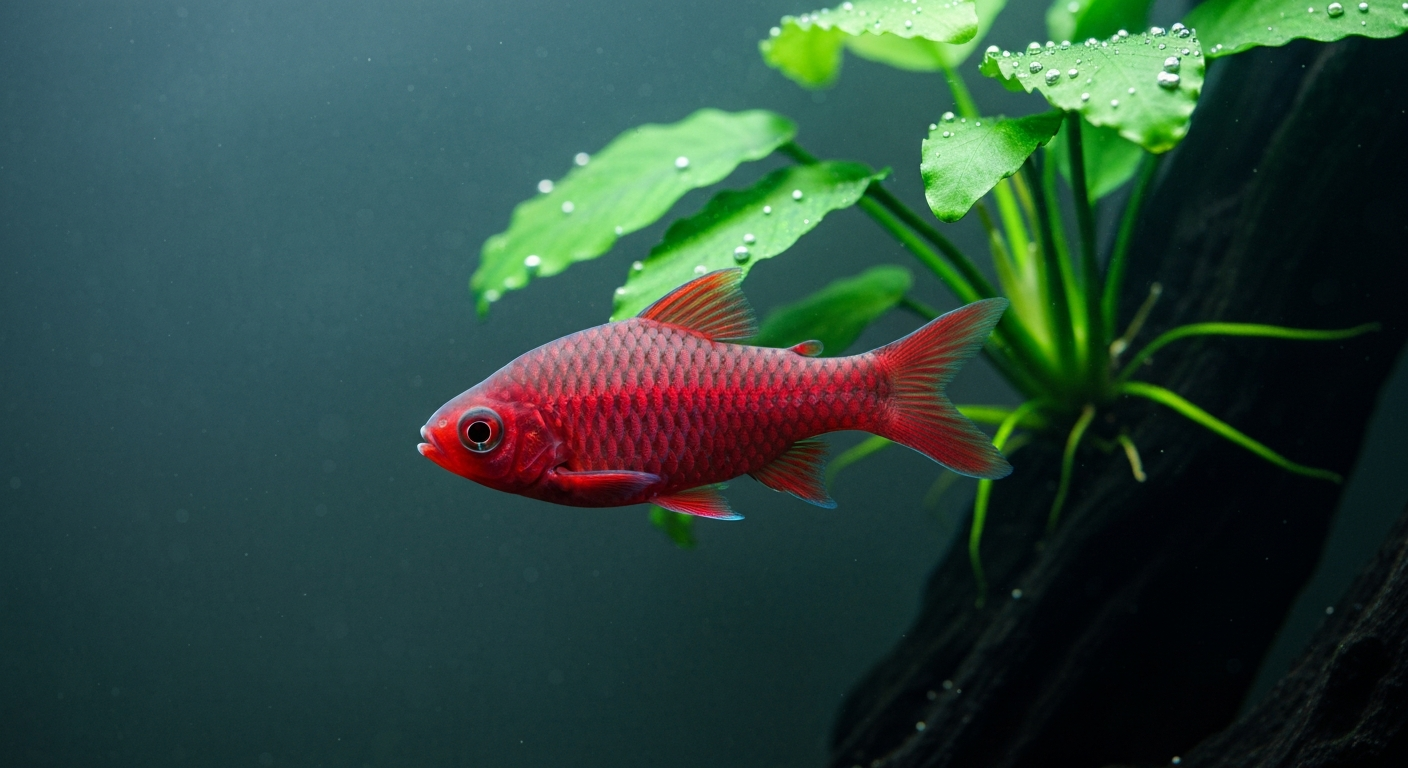
Many barb species have a bad reputation for being aggressive "fin-nippers" that terrorize tank mates. The Cherry Barb is the complete opposite. These peaceful, schooling fish are incredibly active, hardy, and add a brilliant pop of deep cherry-red to your tank (especially the males when they are trying to show off).
Cherry Barbs are native to shaded, slow-flowing streams in Sri Lanka. Because they naturally live in heavily vegetated waters, they love planted aquariums but are highly forgiving of water parameter fluctuations. They easily adapt to pH levels from 6.0 to 8.0 and can tolerate temperature drops down to 73°F without issue, though keeping them at a stable 78°F with a heater is best.
Quick Specs:
· Average Price: $4.00 each
· Adult Size: 2 inches
· Minimum Tank Size: 15 gallons
· Pro-Tip: Always keep them in a school of at least 6. When kept alone, they get stressed, lose their beautiful red color, and hide constantly.
3. Zebra Danios (Danio rerio)
Zebra Danios are the absolute terminators of the freshwater world. They are so hardy that scientific laboratories use them for genetic research because they breed easily and survive almost anything. Characterized by horizontal, zebra-like blue and gold stripes, they are constantly buzzing around the top half of the tank like tiny torpedoes.
What makes Zebra Danios unique is their incredible temperature tolerance. They can live in unheated setups down to 65°F or heated tropical setups up to 78°F. This makes them perfect for simple, budget-friendly desktop tanks where you don't want to run a heavy-duty heater. They are also incredibly forgiving of minor ammonia spikes that occur during the initial aquarium nitrogen cycle.
Quick Specs:
· Average Price: $2.00 each
· Adult Size: 2 inches
· Minimum Tank Size: 10 gallons
· Pro-Tip: They love a strong water flow. Placing your filter output so it creates a current will keep them happily swimming and exercising against the stream.
4. Harlequin Rasboras (Trigonostigma heteromorpha)
If you want a fish that moves in a perfectly synchronized, tight-knit school, the Harlequin Rasbora is your best bet. These beautiful fish have a striking metallic copper body with a distinct, triangular black wedge on the back half of their body (resembling a "pork chop").
Harlequins are incredibly peaceful and make excellent companions for betta fish (as detailed in our Betta Tank Mates Guide). They are exceptionally hardy and can live for up to 5 years with basic care. They thrive in soft, slightly acidic water but will easily adapt to standard tap water as long as you use a quality water conditioner like Seachem Prime ($8) to neutralize chlorine.
Quick Specs:
· Average Price: $3.50 each
· Adult Size: 1.75 inches
· Minimum Tank Size: 10 gallons
· Pro-Tip: Buy at least 6 to 8. The larger the group, the tighter they will school, creating an incredibly elegant, shifting metallic display in the center of your tank.
5. Bronze or Albino Corydoras (Corydoras aeneus)
Every aquarium needs a "cleanup crew" to help vacuum up loose food that falls to the bottom before it rots and pollutes the water. Corydoras (or "Corys") are tiny, armored bottom-dwelling catfish that spend their entire day snuffling through the substrate looking for leftovers. They are peaceful, highly social, and have comical, expressive faces with tiny whiskers (barbels).
While some specialized Cory species are delicate, the Bronze and Albino varieties of Corydoras aeneus are built like biological tanks. They can breathe atmospheric air from the surface if the water oxygen level drops, and they easily handle a wide range of water parameters.
Quick Specs:
· Average Price: $5.00 each
· Adult Size: 2.5 inches
· Minimum Tank Size: 15 gallons
· Pro-Tip: Never use sharp gravel. Corys root through the bottom using their delicate whiskers; sharp gravel will wear them down, leading to painful infections. Always use a smooth sand substrate ($15 for a 20lb bag of pool filter sand works perfectly).
6. White Cloud Mountain Minnows (Tanichthys albonubes)
Known as the "working man's neon tetra," White Clouds are a gorgeous coldwater species native to the Mount Cloud region of China. They have a shimmering silver-green body highlighted by a bright, glowing pinkish-red stripe and red tail fins.
Because they are a coldwater fish, they do not require an aquarium heater. They are happiest at temperatures between 60°F and 72°F, meaning you can keep them in a standard room-temperature tank year-round. This saves you money on equipment and eliminates the risk of heater malfunctions. They are incredibly hardy, disease-resistant, and highly active swimmers.
Quick Specs:
· Average Price: $2.50 each
· Adult Size: 1.5 inches
· Minimum Tank Size: 10 gallons
· Pro-Tip: Their colors intensify dramatically when kept in a planted tank with a dark substrate. The contrast of their red fins against green Java Fern is stunning.
7. Guppies (Poecilia reticulata)
Guppies are the undisputed kings of the hobby. They are famous for their massive, flowing, veil-like tails and neon coloration. They are active, highly inquisitive, and will quickly learn to swim to the front glass to "beg" for food whenever you walk into the room.
Guppies love hard, alkaline water (which matches most municipal tap water) and are highly forgiving of beginner water parameter swings. They are incredibly easy to feed, happily gobbling up flakes, pellets, or freeze-dried daphnia. However, like Platies, they are livebearers and will breed rapidly.
Quick Specs:
· Average Price: $3.00 each
· Adult Size: 2 inches (females are larger, males are more colorful)
· Minimum Tank Size: 5 to 10 gallons
· Pro-Tip: If you don't want millions of babies, buy only males. Male guppies are much more colorful anyway, and they will live peacefully together in a small bachelor group.
8. Kuhli Loaches (Pangio kuhlii)
If you want something unique that looks like a tiny, swimming water noodle, the Kuhli Loach is an absolute joy. These peaceful, eel-like fish have yellow and dark brown vertical stripes and spend their time wiggling through plants, squeezed under driftwood, or buried in the sand with just their eyes poking out.
Kuhli Loaches are highly disease-resistant and can live for over 10 years. They are excellent scavengers, keeping your substrate clean. While they are nocturnal and can be shy at first, they quickly become bold and active once they realize they are safe.
Quick Specs:
· Average Price: $4.50 each
· Adult Size: 3.5 inches (very thin, low bioload)
· Minimum Tank Size: 15 gallons
· Pro-Tip: They are escape artists. Make sure your tank has a tight-fitting lid, and cover your filter intake with a pre-filter sponge ($3) so they don't accidentally swim up the tube.
9. Neon Tetras (Paracheirodon innesi)
No beginner list is complete without the Neon Tetra. These iconic fish feature a glowing electric-blue horizontal stripe paired with a striking crimson-red tail. When kept in a school, they look like floating neon lights drifting through your tank.
Neons are peaceful, stay very small, and have a minimal impact on your tank's water quality (low bioload). They thrive in established tanks and love heavily planted setups with plenty of hiding spots. They are easy to feed and make wonderful companions for community aquariums.
Quick Specs:
· Average Price: $2.50 each
· Adult Size: 1.25 inches
· Minimum Tank Size: 10 gallons
· Pro-Tip: Only add Neon Tetras to a tank that has been running and cycled for at least 4 to 6 weeks. While they are hardy in stable water, they struggle in brand-new setups where the water chemistry is still fluctuating.
10. Bristlenose Pleco (Ancistrus cirrhosus)
Many beginners walk into a store and buy a "Common Pleco" to eat algae, not realizing those fish grow to a monstrous 24 inches long and require a massive 150-gallon tank. The Bristlenose Pleco is the perfect, dwarf alternative. They top out at a manageable 4 to 5 inches and are the absolute champions of scraping green algae off your glass and decorations.
They get their name from the comical, soft fleshy tentacles that grow on the noses of mature males. Bristlenose Plecos are armor-plated, incredibly tough, and spend their days vacuuming glass or resting on pieces of natural driftwood.
Quick Specs:
· Average Price: $7.00 each
· Adult Size: 5 inches
· Minimum Tank Size: 20 gallons
· Pro-Tip: They must have natural driftwood in their tank. Sucking on wood helps them digest their food properly. Also, supplement their diet with a weekly slice of raw zucchini weighted down with a fork — they will go absolutely crazy for it.
My Top Beginner Fish Buying Rule
Never buy on impulse. Check these 5 things before paying.
A $5 fish can cost you a $100 mistake.
If a fish store clerk tells you "it should be fine in a small bowl," they are trying to make a sale. Always look up the species guidelines on a trusted resource first.
Alex Rivera
I've kept and bred dozens of freshwater species over the past 7 years. Everything in this guide is based on real mistakes I've made, tanks I've run, and fish that have successfully survived my early learning years.